Every few weeks a new "best AI model" arrives, and it's tempting to simply use whichever is on top.
That's like buying a lorry to do your weekly shop. It'll get the shopping home. You'll just pay for a lot of lorry.
Model names change faster than anyone can keep up with, so this guide teaches a method rather than a ranking. I'll use today's models as examples. The method should still work when they're old news.
The three things that trade off
Cost. AI text is billed in tokens, small chunks of text. Roughly, one token is three-quarters of a word. Prices are quoted per million tokens, and you pay for what you send in and what comes back.
These are API prices: what developers pay to plug a model into their own apps. A chat app's monthly subscription is a different thing. The prices below come from OpenRouter, a marketplace that lists many models, blended so input and output count together, as on our /compare page.
Quality. Nobody measures this with one number. A benchmark is a standard test given to many models so their scores can be compared. Epoch AI, an independent research group, rolls many of them into one capability index. That's useful for a shortlist. It tells you little about whether a model will write your email in your voice.
Speed. Latency is the wait before an answer starts. Speed is how fast it then writes. Both matter if you're chatting live. Neither matters much if a job runs overnight.
Here is where the first lesson sits. In the data we pulled on 14 November, six models look like this:
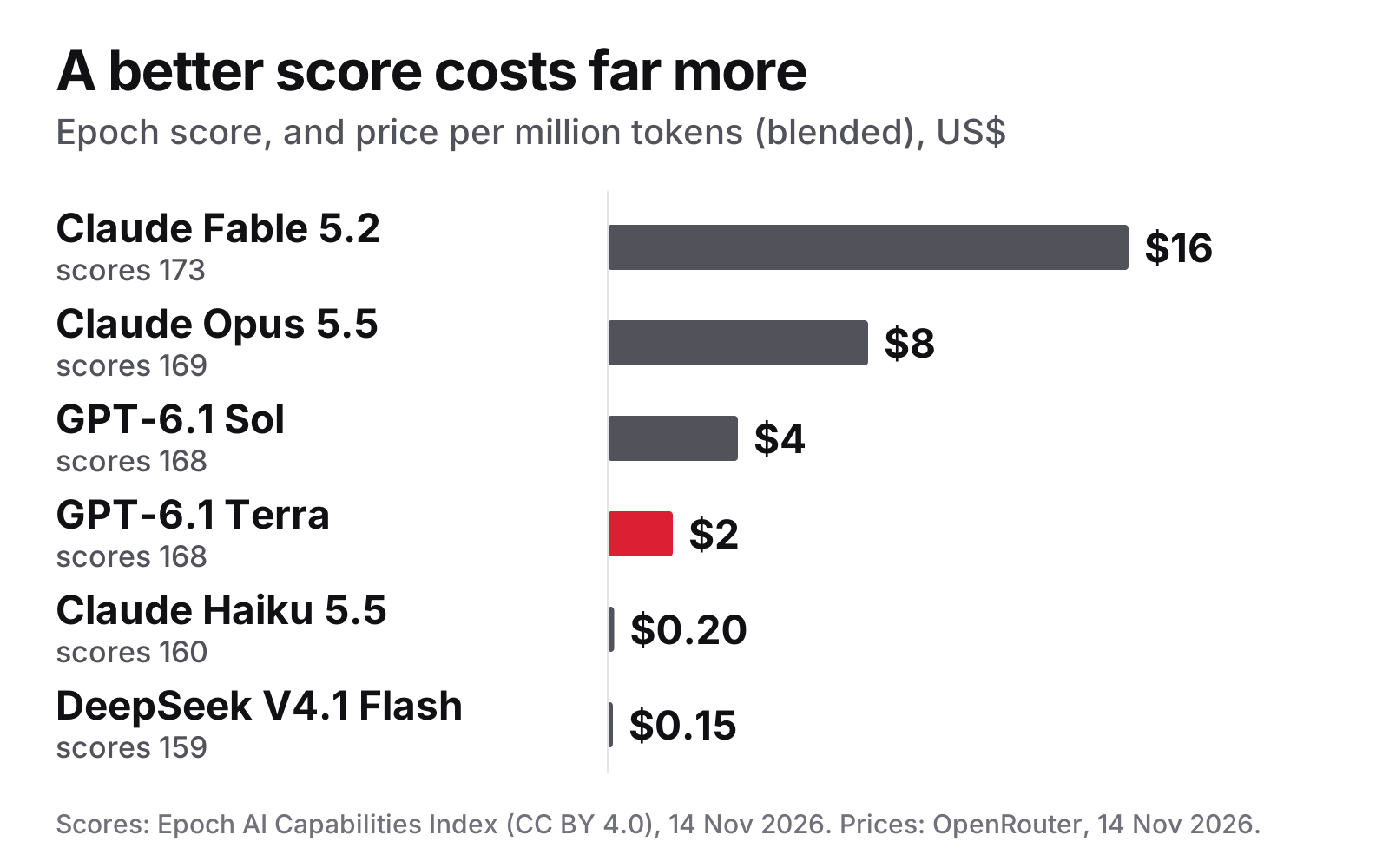
Fable 5.2 has the top score, 173. GPT-6.1 Terra scores 168 for an eighth of the price. Claude Haiku 5.5 scores 160 for an eightieth. We covered how close the top is in our look at the Fable 5.2 price.
Past a certain point, each extra score point gets very expensive.
Quality has a ceiling, and your task may be below it
Most everyday jobs sit well below what any current model can do. Summarising a page, tidying an email, explaining an error message: a budget model handles all of these. Paying 80 times more buys you nothing visible.
The extra money starts to matter on hard, open-ended problems, where a cheap model gets it wrong and you can't easily tell. One of the clearer gaps in our data is advanced maths. On FrontierMath, a very hard test, Fable 5.2 scores about 95% and Terra about 91%. That's a real gap on research-grade problems. It's not one most people will meet.
The method: four steps
- Write down the task, and what a bad answer would cost you. A typo in a draft costs nothing. A wrong number in a report to your boss costs a lot.
- Pick three models at different prices: one budget, one middle, one top. Two or three from different makers is better than three from one.
- Run the same five real tasks through all three. Use your own material, not a demo.
- Choose the cheapest one that passes, then re-test occasionally. Models get cheaper and better every month.
Five tasks is a small sample, and that's fine. You're not publishing a study. You're checking whether the cheap one is obviously worse.
Worked example 1: coding
Say you're a student fixing bugs in a small web project.
Coding has a benchmark worth knowing: SWE-bench Verified, which gives a model real bug reports from open-source projects and checks whether its fix works. Epoch's run in our data is out of date, though. The newest model in it is Claude Opus 4.7 (83.5%), and none of the current top models are listed. So I can't tell you from the numbers which new model codes best.
That's the honest answer, and it's why step 3 exists. Take three real bugs from your code. Give each model the error and the relevant file. Does the fix run? Does it break something else?
My bias: start with a mid-priced model such as Claude Sonnet 5.5 or GPT-6.1 Terra ($4 and $2). Move up only if it keeps going in circles. Also note that the same task can cost very different amounts. Coding tools often send whole files, and tokens add up fast.
Worked example 2: writing
Say you're drafting a cover letter, or tidying a blog post.
Here, benchmarks barely help. "Good writing" is partly taste. The public vote on LMArena, where people pick the better of two anonymous answers, is closer to taste than a test score. Even so, it measures the average person's preference. Not yours.
So test it by blind comparison. Paste the same prompt into three models and read the answers without looking at which is which. You'll often prefer the cheap one, or find them indistinguishable.
Here the arithmetic is kind. A 1,000-word draft is roughly 1,300 tokens out, plus your instructions. At $0.20 per million tokens that costs a fraction of a penny. At $16 it's still only a couple of pennies. For one-off writing, cost hardly matters, so use whichever you like reading.
Cost starts to matter when you run it thousands of times, for instance a chatbot or a mailing tool.
Worked example 3: data analysis
Say you have a spreadsheet of survey answers, and you want trends.
This is where the risk is. Language models are fluent, and fluent isn't correct. A model can state a wrong average with total confidence.
Two habits help more than any model upgrade. First, ask the model to write the formula or a short script, not to do the sums in its head, and then run that yourself. Second, spot-check three numbers by hand.
On maths-heavy work, the pricier models do have an edge, and wrong numbers are expensive. A reasonable plan: draft with a mid-priced model, then run the most important questions through a top one as a second opinion. If they disagree, you've found the place to look closely.
What about speed?
I don't have trustworthy independent speed figures for these models, so I won't invent any. Companies publish their own claims, and "up to" figures describe the best case.
Judge it yourself. Time the same prompt on each model, three times, at the hours you'd really use it. Note how long until the first words appear, and how long until it finishes. Small models are usually quicker, but check rather than assume.
Speed matters most for live chat and for tools that wait on the answer. For anything you can leave running, ignore it.
Don't forget the hidden costs
- Price per token is not price per answer. A model that writes at length, or thinks out loud before answering, can use several times more tokens. You pay for all of them.
- Context window. That's how much text a model can hold in view at once. If your document is longer, it forgets the start. Check the limit before you paste in a book.
- Prices change. Some are introductory and rise later. Re-check before building anything lasting.
- Open or closed. Open-weights models, whose files anyone can download, can be cheaper to run, but not always. We explain why in our Kimi K3.1 Pro piece.
The short version
Treat leaderboards as a way to build a shortlist. Treat your own five-task test as the verdict.
Start cheap. Move up one tier at a time. Pay for the top model when a mistake would cost more than the bill, which for most people is rarely.
If you want a place to see current scores and prices side by side, our /compare page has them. And for how quickly this all moves, see five models in 17 days.