"2.5 trillion" sounds like a lot, and it is. But it tells you much less than you'd think.
Here's what's actually been said about xAI's next model, who said it, and what's still missing.
What was claimed
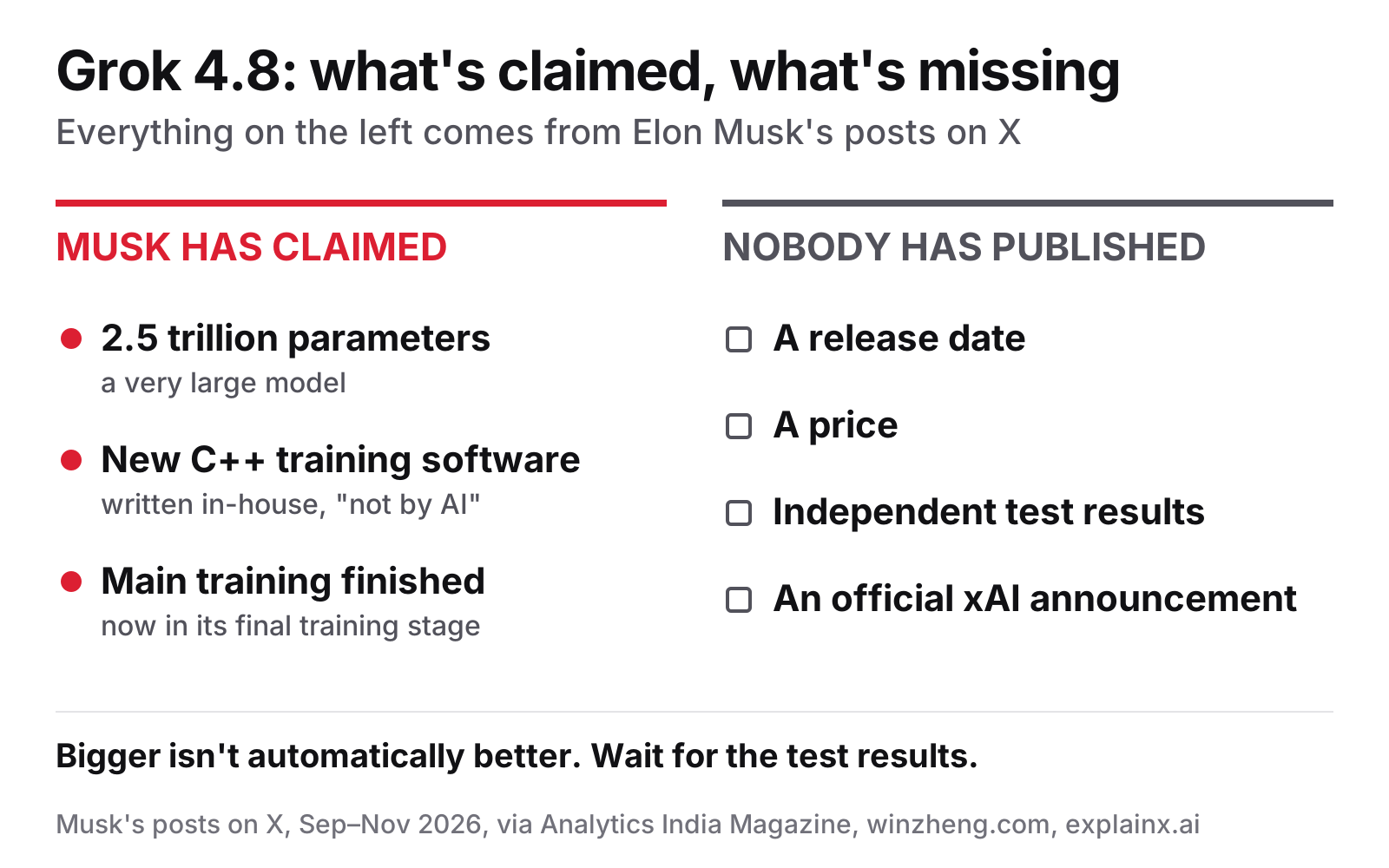
Around 14 September, Elon Musk posted on X about Grok 4.8. Press accounts quote him calling it "a 2.5T model trained with our new C++ software stack". The "T" is trillion: 2.5 trillion parameters. He said it would finish its main training that week and move on to reinforcement learning (RL), the stage where a model practises on problems and gets rewarded for good answers.
So the source is Musk, not an xAI announcement. We couldn't open the original post, and one outlet dates it to 13 September, so treat the day as approximate. The size figure is Musk's, with nothing published to check it against.
Analytics India Magazine reports more from the same thread. Musk wrote that the training software is "now an internally developed stack in C and C++", written by Starlink's software team, and "not written by AI". He called the RL side "still somewhat of a legacy pile" of third-party tools.
What the jargon means
Parameters are the adjustable numbers inside a model, the dials set during training. Think of them as the model's brain cells. 2.5 trillion of them is a very big model. Bigger models can hold more knowledge, but they cost more to train and run.
A software stack is the layers of code that drive the training: the programs that spread the work over thousands of chips and keep them busy. C++ is a fast, low-level programming language. Rewriting in it is a bet that you'll waste less of your expensive hardware. One Google engineer quoted in the same report guessed that's part of why xAI ships so many models. That's a guess, not a measurement.
What happened since
A 10 November report relays more Musk posts. He said the main training was done, "4.8 is in RL and the evals are starting to climb", and that a soft rollout to some Grok users would come "later this week". He also said xAI had rewritten the rest of its software in C and C++ too.
That page's author hadn't checked the original posts either, and found no confirmation from xAI that the rollout happened. "Evals climbing" means internal test scores going up, and Musk gave no numbers.
What nobody has published
No model card, the fact sheet a lab publishes with a model. No price. No release date. No test results. As far as we can find, xAI hasn't put out its own post on 4.8. Any score you see before an independent test is Musk's word.
That includes the size. Size alone doesn't predict quality. A well-trained smaller model can beat a badly-trained bigger one, and that has happened many times across the industry.
For scale, the top of Epoch AI's capability index (one score built from many hard tests) is Claude Fable 5.2 on 173 (see our write-up). Grok 4.8 will need an independent score before anyone knows where it fits. When it gets one, you'll be able to compare it on our /compare page, or see how five other recent launches landed.
My read
The C++ story is more interesting than the size. If it really lets xAI get more useful work out of its hardware, that's a genuine advantage. But it's a claim about efficiency, and efficiency only matters if the finished model is better. Until it's out and tested, we don't know.
Who should care
If you use Grok for work, nothing changes today. Stay on the version you have and don't build plans around 4.8 until there's a price and a score from someone other than xAI.
If you're just following the race, treat "2.5 trillion" as a headline, not a result. The thing to watch for is an independent score, from Epoch AI or a public leaderboard, not another post.